
The story goes that, in 1800, after Napoleon won the battle of Marengo against the Austrians, his chef foraged through a local village for ingredients with which to create a celebratory meal. He turned up a scrawny chicken, some tomatoes, garlic, oil, and a few crayfish, and turned it into a dish that Napoleon liked so much, he requested the chef to prepare it for him after each victory. He objected when, one time, the chef substituted mushrooms for the crayfish; it had to be the same every time.
It’s a great story, but it’s probably a myth. Most likely, the chef of a Parisian restaurant created the dish we now call “Marengo” to celebrate the victory. Indeed, I wondered about the origin when I first read the story. After all, tomatoes are a New World plant that wasn’t introduced to Europe until the Columbian exchange of the early 16th century. Europeans were very leery of the tomato, because the plant is in the nightshade family, which includes numerous toxic plants. So tomatoes were grown more as ornamental plants. The fruits (botanically, a tomato is a fruit) were first eaten in Spain, then were gradually accepted through the Mediterranean in the 18th and 19th centuries. So finding some ripe tomatoes in a small village didn’t seem very plausible to me.
Wherever it actually came from, chicken Marengo is delicious. So is the variation made with veal, which is what I cooked last night.
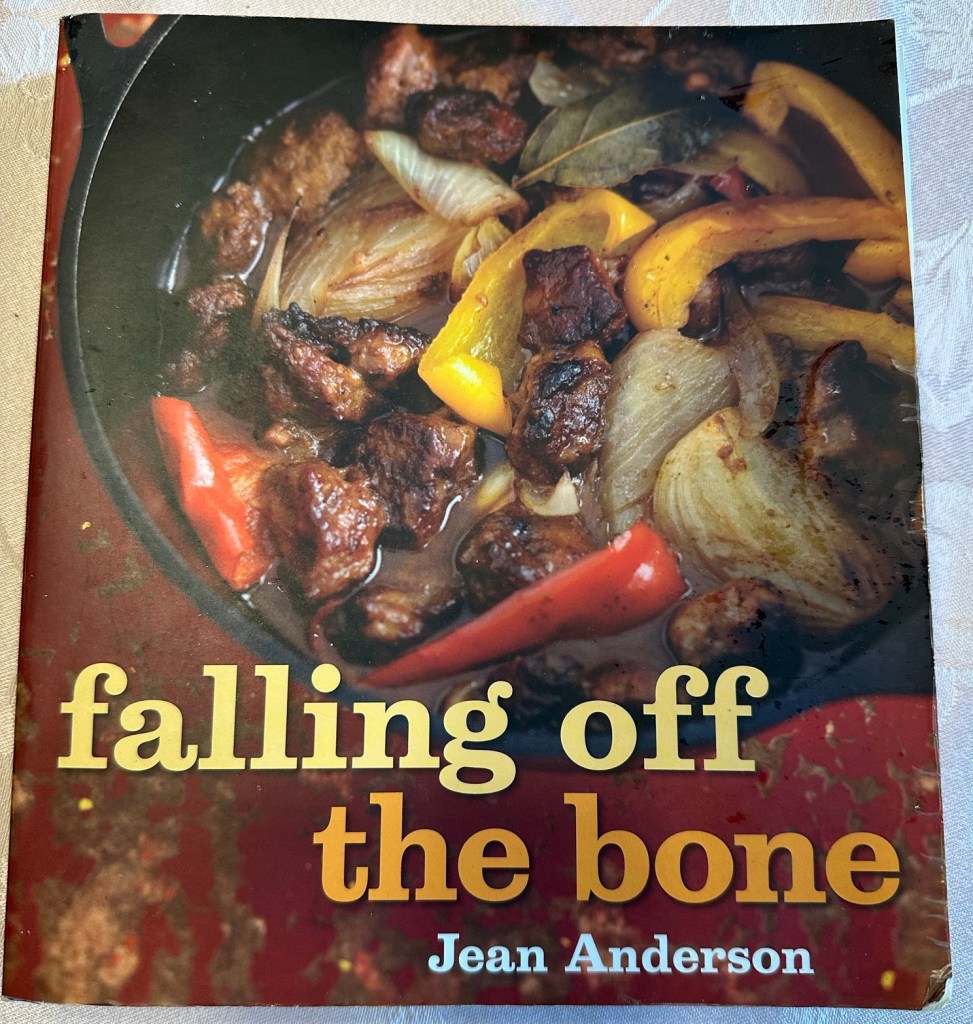
When I went to the market for the ground bison Ken needed for his chili two weeks ago, I hit the red meat jackpot. In addition to a sale on a couple beautiful little boneless beef top sirloin steaks, I found lamb cubes and veal cubes. Neither of those is something I usually find there, so I scooped them up. Then I pulled out my favorite meat cookbook, Falling Off the Bone by Jean Anderson.
Although there are a number of interesting looking veal stews in the cookbook, the only one I look at here is veal Marengo. When we have veal, it’s a 50-50 shot as to whether I’ll cook Marengo or a veal stew from an old Time-Life cookbook with horseradish, that is purported to be Bulgarian. If Alice were here, she would have lobbied for the other recipe, but since she wasn’t, Marengo it was.

This is what stew is all about: browned meat plus vegetables, slowly cooked in a rich broth. There are no crayfish in my dish, but there are plenty of mushrooms and a healthy portion of white wine in the sauce.
I did have a minor issue while I was cooking. The recipe calls for three pounds of cubed veal, but I had just a little more than a pound of meat. I didn’t want to cut down the amount of vegetables and sauce, because, honestly, the sauce is my favorite part. I thought, though, that I could still use my little Dutch oven. A couple of years ago, I thought it would be nice to have a small pot, rather than putting a cut down recipe in my large Dutch oven. So I found a nice 1.7-quart enameled cast iron pot on Amazon, and I love it. It became apparent, though, as I was browning the veal cubes, that the pot was not going to be big enough. I ended up moving the browned veal to my large pot; at least I figured it out before I tried to put all the ingredients in the small one and created a mess.
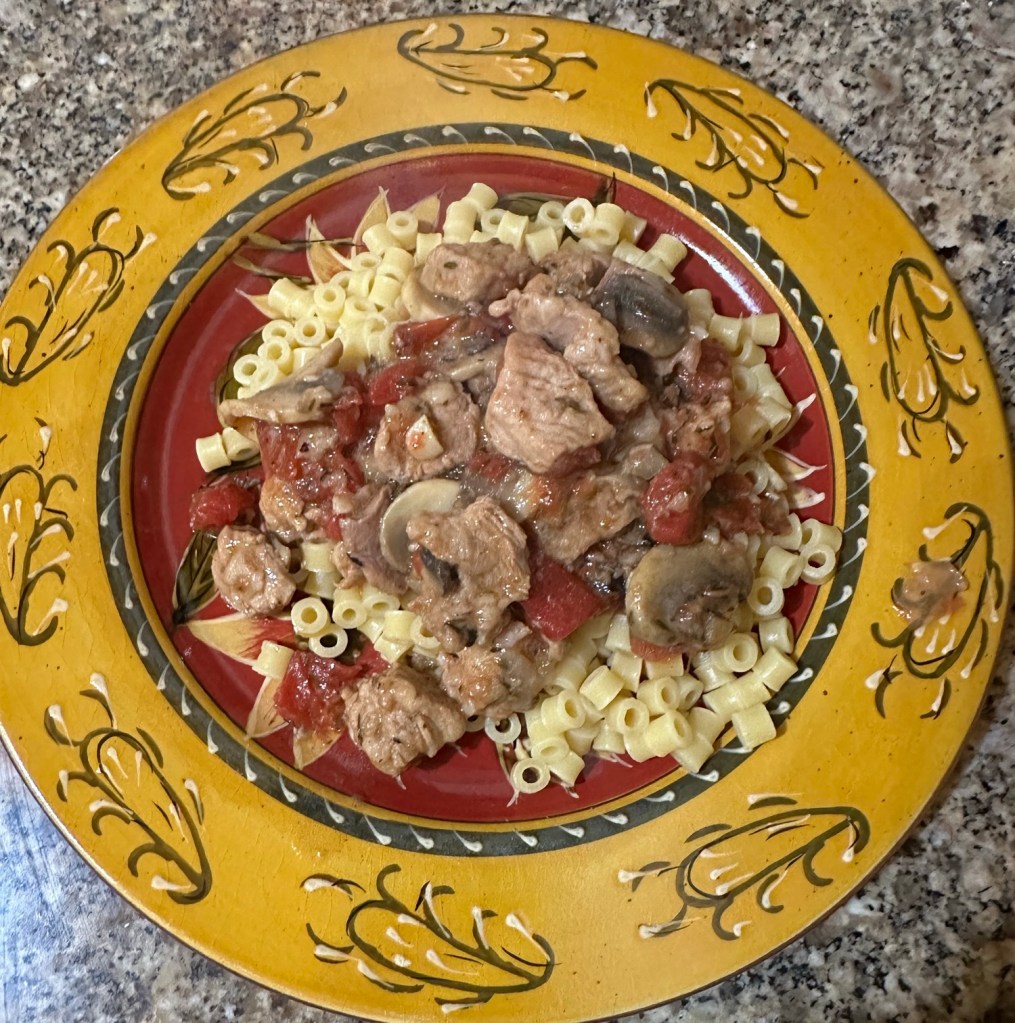
Veal Marengo
- 1 lb. boneless veal, cut into 1-inch cubes
- 1/4 cup flour combined with 1/4 teaspoon salt and a few grindings of black pepper
- 2 tablespoons (or more) olive oil
- 1 cup coarsely chopped onion
- 8 oz. mushrooms, sliced
- 2 large garlic cloves, minced
- 1 strip orange zest, 3 to 4 inches long and 1/2 inch wide
- 2 teaspoons dried thyme
- 1 cup dry white wine
- 1 14-ounce can diced tomatoes, drained
- 1 cup low sodium chicken broth
- Chopped parsley for garnish, optional
Preheat oven to 325 degrees.
Dredge veal in the flour mixture. Heat oil in a Dutch oven over medium high heat. Brown veal in batches so as not to crowd the cubes, about 7-8 minutes per batch. Remove veal to a bowl as it browns.
If necessary, add an additional tablespoon of oil to the pan. Add onion, mushrooms, garlic, orange zest, and thyme to the pot and sauté, stirring often, until limp and slightly browned, about 8 to 10 minutes. Return veal to pot along with accumulated juices. Add wine, tomatoes, and broth, and bring to a boil.
Cover pot and put on middle rack in oven. Braise until the veal is tender, 1 1/2 to 2 hours. Taste for seasoning, and add salt and pepper as needed. Discard orange zest. Garnish with parsley. Serves 4.
I’ve generally served this over egg noodles, but decided to use ditalini this time. I’ve seen recipes that call for serving it over rice or pasta, and some that simply serve it with crusty bread. No matter what you choose, it’s delicious.
Happy eating!





Leave a Reply